’Tis thought the King is dead. We will not stay. The bay trees in our country are all withered, And meteors fright the fixèd stars of heaven; The pale-faced moon looks bloody on the Earth, And lean-looked prophets whisper fearful change; Rich men look sad, and ruffians dance and leap, The one in fear to lose what they enjoy, The other to enjoy by rage and war. These signs forerun the death or fall of kings.
The quotation above, from Shakespeare’sRichard II, seems to contradict a basic principle of medieval monarchy, summed up in the famous proclamation, “The king is dead, long live the king!” The kingship was an institution; the king was a man. The death of the king was no cause for alarm or disorder, because the kingship passed naturally and immediately to his rightful successor.
But Shakespeare’s bay trees were not amiss when they withered, and justly was the moon well tinted with blood—for the king who followed Richard II was not a successor, but a usurper. The signs spoke not merely of a body succumbing to death but of a sacred institution under siege. They foretold not a peaceful transfer of power but a social disease that would originate in this grievous wound to the body politic. Reverence for the king was the keystone of civic duty in the monarchical cultures of the Middle Ages, much as the king was the keystone of a feudal hierarchy that allowed remarkably well-ordered societies to exist and flourish in an era when communication was slow, power was decentralized, and enemies were plentiful. To damage this keystone was to imperil the entire edifice.
And yet, we must not overlook the dual nature of this word “king,” which encompasses both the person and the office. If there was ever a civilization that was realistic about the inevitability of death, it was the Christian civilization of the Middle Ages. Medieval communities understood that their monarchs were mortal; they were well acquainted with the illnesses, wars, and political rivalries that might bring royal lives to a premature end; and they knew that no one was so powerful in life as to escape the dread judgment of the King of kings after death. It was only natural, then, for subjects to look beyond the monarchs themselves when hoping for a safe and prosperous realm: He who received the crown had been consecrated, but the crown was sacred. To the man was owed loyal service, but to the office was owed a profound and almost religious reverence. The sovereign would perish; the institution would endure. The king was dead—long live the king.
Did Politics Exist in the Middle Ages?
Politics, understood broadly, is present wherever human beings live and work together. The term derives from Greek polis, meaning “city” or “community,” and suggests “that which pertains to public life.” In the modern West, however, the term “politics” is so strongly associated with democratic elections that we must be careful when projecting it back into the societies of Christendom. For us, “politics” may conjure memories of demagogic, wildly expensive, and sometimes highly unedifying cycle of rallies, debates, interviews, advertisements, and so forth by which candidates persuade ordinary citizens to vote for them. If this is what we call politics, then the answer to the above question is “no”: politics did not exist in the Middle Ages.
Even if we decouple political experience from modern elections, we can still say that for a large portion of the Middle Ages, politics was not a distinct field of study and was not perceived as an independent sphere of human life. Medieval philosophers and theologians saw politics as something akin to what modern thought calls sociology: What is the nature of human society? How should it be structured and governed? What is its purpose? These were “political” questions for medieval culture, and they were thoroughly interwoven with spiritual and ecclesiastical questions.
Scholarship in this field became more recognizably political in the High Middle Ages, after Aristotle’s Nicomachean Ethics and Politics were rediscovered. These treatises were quite different from the book that served as the principal political text in the early Middle Ages—namely, the Bible. During the High Middle Ages, political sociology started to look more like what we might call political science: it was more secular, explored the notion of the State as a governmental entity, and spoke more directly to issues of power, consent, and representation. Nonetheless, politics was still bound up with the authority of the Church, the primacy of justice over absolute power, and the eternal destiny of mankind.
And make no mistake: the era of liberal electoral democracy—in which rights supplant duties, votes supersede doctrines, and rulers answer to citizens rather than to God—was still a long way off.
Justice in Medieval Culture
To fully understand the nature of politics and civic duty in the Middle Ages, we must consider the virtue of justice, to which modernity assigns an increasingly narrow and dubious meaning. Nowadays, justice is prominent in the domain of criminal prosecution and in controversial social movements. In the past, it permeated all of society, functioning as a conceptual aqueduct by which metaphysical, psychological, and pragmatic principles of the highest importance were introduced into the messy business of communal life. Justice is traditionally summarized as “rendering unto others that which is their due,” and if we take this definition to its logical conclusion, we can see why it was the preeminent civic virtue and the very foundation of human society:
[Justice] applied to relationships between individuals and between the individual and the community, regulating these relationships according to the orderly equilibrium of the cosmos and the preconditions of human happiness. If we extend “others” to heavenly beings or to God Himself, justice becomes a spiritual and religious reality that brings the human soul into harmony with divine goodness and transcendent truths.[i]
Continuing the aqueduct analogy, we can imagine justice as a political lifeblood that arrives from on high and sustains the polis as it is distributed, through various channels and means, to every member of the community. Like water, it is a shared resource that flows both vertically, through the social hierarchy, and horizontally, among members of similar social standing. And again like water, people thirst for it, desire it, depend upon it—but don’t always know how to find it.
The notion of “rendering to others their due” is simpler in theory than in practice, and we should ask how justice, understood in terms of civic duty and political authority, actually played out in medieval culture. Since “medieval culture” is shorthand for a large number of related cultures that inhabited all of western Europe over the course of a thousand years, we will answer the question by briefly examining justice in two antecedent cultures—namely, the Roman and the Germanic—from whose convergence medieval civilization emerged.
Germanic justice was built around a strict code of honor, restitution, and revenge. In the case of murder, an offender’s violation of justice would be rectified through retributive bloodshed or bloodless compensation based on the wergild, literally the “man payment” (gild is the ancestor of modern English “yield”). For the founding fathers of the United States, the notion that “all men are created equal” was a “self-evident” “truth.” It turns out that the notion was not self-evident to Germanic tribes, which assumed that a person’s wergild depended upon his or her social status. A murdered feudal lord, for example, was “worth” more than a murdered peasant, and though this is highly offensive to the ears of modern equality culture, we must think about the issue in terms of justice. It was “self-evident” to Germanic peoples that the loss of a powerful chieftain or renowned warrior or noble lady was a more grievous wound in the body politic than the loss of a shepherd or blacksmith. The higher wergild corresponded to the larger social debt incurred by the offender, and the larger social debt corresponded to the graver social threat: if you kill a king, society might devolve into chaos; if you kill a wealthy landowner, many other lives might be disrupted; if you kill a peasant, however tragic the death may be on a personal level, the community as a whole is largely unharmed. The wergild also memorably illustrates the intensely communal, relational nature of medieval justice: in some cases, part of the wergild would be paid to the king—not necessarily because he had a close kinship with the victim, but simply because he lost one of his subjects! The offender has incurred a debt on multiple levels of society. He has brought dangerous imbalance to a communal structure in which everything is interrelated and interdependent. All debts must be repaid; balance must be restored.
Vengeance had a place in the culture of ancient Rome as well, but Roman justice nonetheless presents an appearance quite different from that of Germanic justice, for two reasons: it was more thoroughly intertwined with the concept of abstract virtue and more clearly rooted in a formalized legal system. In De partitione oratoria (XXII.78), Cicero calls justice “the part of virtue displayed in society” and suggests its kinship with virtue directed to the gods (religio) and to parents (pietas). And in De finibus bonorum et malorum (V.23), he describes justice as a form of solidarity to which “dutiful affection, kindness, liberality, good-will, and courtesy” are joined, and which
spreads its influence beyond the home, first by blood relationships, then by connections through marriage, later by friendships, afterwards by the bonds of neighborhood, then to fellow-citizens and political allies and friends, and lastly by embracing the whole of the human race.
If Roman justice is the essence of social virtue, we must conclude also that it is inseparable from the rule of law, for Roman society was a supremely legal society. A large proportion of the world’s population continues to benefit from legal systems built upon laws drawn up in ancient Rome. The close connection between justice and law in Roman culture is concisely expressed by Florus in the Epitome rerum Romanorum (I.24): referring to Rome’s earliest and most important body of legislation, he writes, “The whole system of justice had been arranged upon twelve tables.”
In his book Life in Medieval France, the historian E. R. Chamberlin memorably summarized the contrast between Roman and Germanic models of political justice: The former relied upon “all-embracing” law, and a man was a citizen bound by his duty to the State; the latter relied upon tribal codes, and a man was a man bound by his duty to the Chief.
The Paradox of Medieval Monarchy
Justice, political authority, civic duty—in medieval culture, all three converged in the body of the monarch. Or perhaps we should say in the bodies of the monarch.
In 1957, a medieval historian named Ernst Kantorowicz published a groundbreaking book entitled The King’s Two Bodies. The central premise is that a medieval king was both an ordinary human with a natural body that will die, and an embodiment of the political community and royal office, which continue from generation to generation. The king was thus a symbol of man’s dual nature, since he had both a physical body subject to decay and a spiritualized body that transcended human mortality. He was also, therefore, a symbol of the divine King, since medieval religion taught that the body of the incarnate God was both a truly human body and a mystical body composed of all Christians in union with Christ.
This “political theology,” as Kantorowicz called it, brought a sense of stability and resilience to medieval societies, and it was a reminder of man’s spiritual destiny in a world that often overwhelms us with the needs and woes of the body. Rather than creating a disconcerting sense of rupture, as elections often do, the king—dressed in his regalia, attended by his noble retinue, wielding his scepter of justice—was an icon of continuity and hope: the king will die, but the kingship and the kingdom will endure. And rather than reinforcing the polarization that is inherent to competitive elections, the wholeness of the king’s body conveyed the unity that the political community, despite inevitable disagreements, should desire and strive for.
The Middle Ages had its fair share of political turbulence, disgraceful monarchs, and fractious citizens. The theory of the king’s two bodies didn’t negate the tendency of politics to bring out the worst in human nature. But we are symbolic beings, and symbols—especially when joined to ideas that excite the imagination and to ceremonies that captivate our senses—are powerful things. A medieval monarch was a living symbol of political ideals, and his symbolic nature helped ordinary citizens to maintain a more wholesome balance in their political lives. Very near the beginning of the post-medieval period, when the wisdom of Catholicism was sometimes overshadowed by the unwise excesses of Humanism, England’s Queen Elizabeth was the object of hyperbolic, almost idolatrous, devotion. Such was not the medieval spirit, which at its best offered service, deference, honor, even affection to the king but reserved full reverence for the sacred institution that the king represented.
Recovering Monarchy in a Democratic Age
Even a cursory glance at history tells us that all forms of government are imperfect. A longstanding truism of modern political theory—“monarchy is bad, democracy is good”—seems not quite so true these days: the citizenry has less trust in electoral systems, democratically elected officials are accused of threatening democracy, and scholars now recognize that postmodern presidents are really rather monarchical and may be more powerful, all things considered, than medieval kings.[ii] Also, as humanity gains more experience with the lived reality of democratic governance, we see that “democracy” is a vague and easily manipulated term. George Orwell observed back in 1946 that
in the case of a word like democracy, not only is there no agreed definition, but the attempt to make one is resisted from all sides. It is almost universally felt that when we call a country democratic we are praising it: consequently the defenders of every kind of régime claim that it is a democracy, and fear that they might have to stop using that word if it were tied down to any one meaning.[iii]
The fixation on “democracy” in modern political discourse is really rather strange from a historical perspective. Renaissance and Enlightenment intellectuals favored the republic, a system of governance that was seen by some as a stable compound of three unstable elements: monarchy, aristocracy, and democracy, which tend to decay into tyranny, oligarchy, and mob rule, respectively.
One thing we can say with confidence about democracy is that there wasn’t much of it in the Middle Ages. This was an era of monarchy, dynastic succession, feudal lords, powerful churchmen, and a few popular uprisings in lieu of elections. It was not, however, an era of tyranny and dictatorship. Though “monarch” literally means “one who rules alone” (from Greek monarkhes), medieval monarchies were highly collaborative endeavors. Theresa Earenfight, a scholar of medieval history, explains that “medieval monarchical power was corporate, never isolated in one person. The king was paramount, but he governed to varying degrees with others—the heir, the queen, councils, and assemblies.”[iv]
Another historian, Ethan Shagan, provides an example of the chasm that separated medieval monarchies from the vast federal bureaucracies or totalitarian police states of the modern era. Here he’s speaking of a regime that existed in the late-medieval/early-modern period, when monarchies were becoming more authoritarian and centralized:
The Tudor government possessed no bureaucracy, no police force, no standing army, and was utterly reliant upon local collaboration—from the haughtiest justice of the peace to the lowliest village constable—for the maintenance of ordinary administration.[v]
Nevertheless, we don’t want to get the wrong idea about this. A medieval monarch was an immensely significant person in his kingdom—not necessarily because he was “one who rules alone,” but because he alone symbolized the ultimate political reality of his realm: namely, that it was a commonwealth composed of those who govern and those who are governed, and in which all decisions must respect human nature as a union of body and spirit.
The age of medieval monarchy has passed. I do not pretend to know which form of government would best respond to the overwhelming complexities of modern life, but I will suggest that the political culture of the Middle Ages is a treasury of wisdom and virtue that can still bring tangible benefits to our lives. A more all-encompassing and metaphysical view of justice, harmonized of course with Christian mercy, can enrich relationships at all levels of society, and the concept of respect for the person, reverence for the office can still inform our interactions with parents, educators, priests, and other authority figures whose leadership, however imperfect, brings order to our communities and keeps fallen man’s anarchical tendencies at bay.
Shakespeare understood where such tendencies would lead. His Richard II was weak, but he was a legitimate king and, therefore, “the figure of God’s majesty.” The playwright, speaking through the Bishop of Carlisle, almost compels us to look back with nostalgia on the era of consecrated Catholic monarchs—an era that is gone but need not be forgotten.
And shall the figure of God’s majesty, His captain, steward, deputy elect, Anointed, crowned, planted many years, Be judged by subject and inferior breath, And he himself not present? O, forfend it God That in a Christian climate souls refined Should show so heinous, black, obscene a deed!
Subscribe to CFN!
[i] Robert Keim, “Was Medieval Warfare a ‘Very Great Good’?” https://viamediaevalis.substack.com/p/was-medieval-warfare-a-very-great, 17 Sept. 2024.
[ii] See, for example, William E. Scheuerman, “American Kingship? Monarchical Origins of Modern Presidentialism”; Marc Landy and Sidney M. Milkis, Presidential Greatness; Michael Novak, Choosing Our King; Jeb Smith, Missing Monarchy: Correcting Misconceptions about the Middle Ages, Medieval Kingship, Democracy, and Liberty
[iii] . George Orwell, “Politics and the English Language.” https://www.orwellfoundation.com/the-orwell-foundation/orwell/essays-and-other-works/politics-and-the-english-language
[iv] Theresa Earenfight, “kingship, queenship, and monarchy,” The Oxford Dictionary of the Middle Ages. Oxford University Press (2010).
[v] Ethan H. Shagan, Popular Politics and the English Reformation. Cambridge University Press (2002), p. 2.
Robert Keim is a secular brother of the London Oratory of St. Philip Neri and teaches university courses in classical rhetoric. He is a linguist, a translator of poetry, and a literary scholar specializing in the poetic and dramatic literature of the English Renaissance. You can subscribe for free to Robert’s Substack newsletter on medieval culture at viamediaevalis.substack.com.
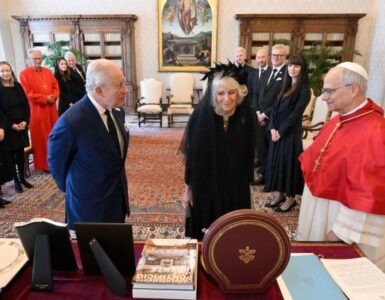
PDF Button Photo Credit: Vatican Media In a state visit that betokened immense amounts of planning, King Charles III and Queen Camilla joined Pope Leo XIV for an ecumenical service at the Vatican today as both parties...
PDF Button Cupich claims Church backing for all migrants Chicago’s Cardinal Blase Cupich has once again courted controversy by weighing in on the immigration controversy and giving the Catholic Church’s full...
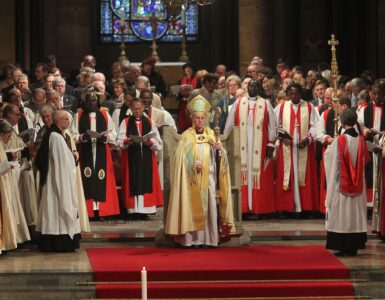
PDF Button By Thomas Colsy Crisis in the Anglican Communion Amid Female Archbishop Appointment, Cathedral Graffiti Controversy, Nigerian Province’s Schism Threat An October 3 announcement has confirmed that for...
Robert Keim is a secular brother of the London Oratory of St. Philip Neri and teaches university courses in classical rhetoric. He is a linguist, a translator of poetry, and a literary scholar specializing in the poetic and dramatic literature of the English Renaissance. You can subscribe for free to Robert’s Substack newsletter on medieval culture at viamediaevalis.substack.com.


 Robert Keim


 Michael Haynes
 Thomas Colsy